

Understanding Your Foot Arches: The Dynamic Foundation of Movement
There’s more to your feet than you might realize. These small structures support your entire body weight as your only point of contact with the ground during walking, running, or hiking. They also serve as the base upon which your whole body organizes itself during dynamic movement. What many people overlook is that feet are designed to be dynamic—they absorb shock, adapt to uneven terrain, and return energy efficiently through their arches.
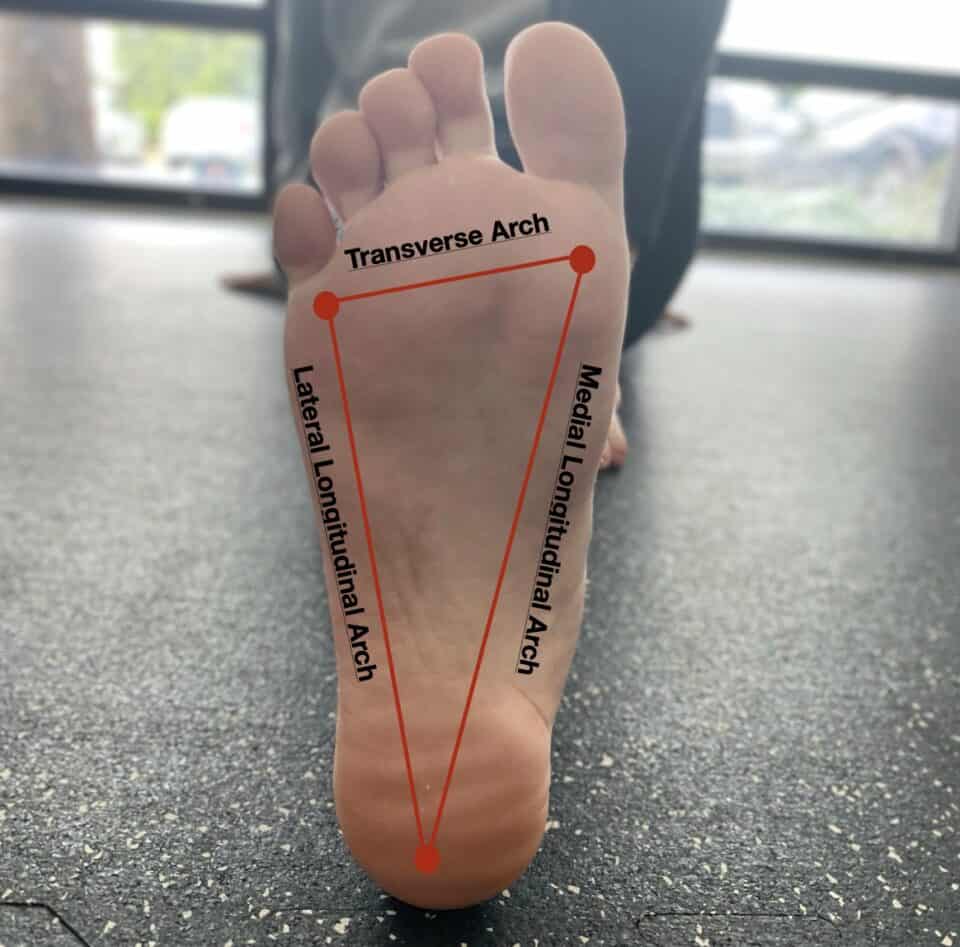
Most know there’s at least one arch in the foot, but there are actually three interconnected arches:
–The Medial longitudinal arch: along the inner side, acting as the primary shock absorber. Supported by the tibialis posterior tendon
–The Lateral longitudinal arch: outer side, providing lateral stability
–The Transverse arch: across the forefoot, aiding push-off
These arches are engineered to be both strong and flexible, functioning like springs that flatten under load and stiffen for propulsion.
So how does this play out in movement?
Consider a typical step in gait. It begins with heel strike, where your heel contacts the ground and your foot starts to pronate (a natural inward roll for shock absorption—not a flaw, as many believe). During mid-stance, as your knee bends and your body weight shifts over the foot, the arches collapse slightly—this increases the foot’s contact area for stability while dissipating impact forces (up to 2-3 times body weight; Bolgla & Malone, 2004). Then, in the push-off phase, big toe extension activates the windlass mechanism: the plantar fascia tightens, elevating the arches and making the foot rigid to propel you forward efficiently (Hicks, 1954; Bolgla & Malone, 2004).
For this cycle to work smoothly, the intrinsic foot muscles (like the abductor hallucis) and lower leg muscles must be strong enough to control the arches. Weakness here can lead to excessive collapse, stressing the knees, hips, or lower back up the chain. A common misconception is that ‘flat feet’ are inherently problematic—they’re often just under-trained (Sichting & Ebrecht, 2021). Strengthening these muscles through targeted exercises can help restore dynamic balance. Using minimally supportive footwear or going barefoot during short walks can further train these muscles, promoting resilience and reducing injury risk.
Try it!
Next time you have a moment, test this yourself. Stand in a split stance (one foot slightly ahead) and slowly bend your front knee. Does the arch collapse during the bend and re-emerge as you straighten? This simple check offers insight into your foot’s dynamic function.
Your feet work tirelessly every day—strengthening their arches supports better movement overall, especially for demanding activities like hiking or running. If pain persists or your test reveals asymmetry, consider a professional assessment for tailored guidance.
- Kestrel Martin, Kinesiology